
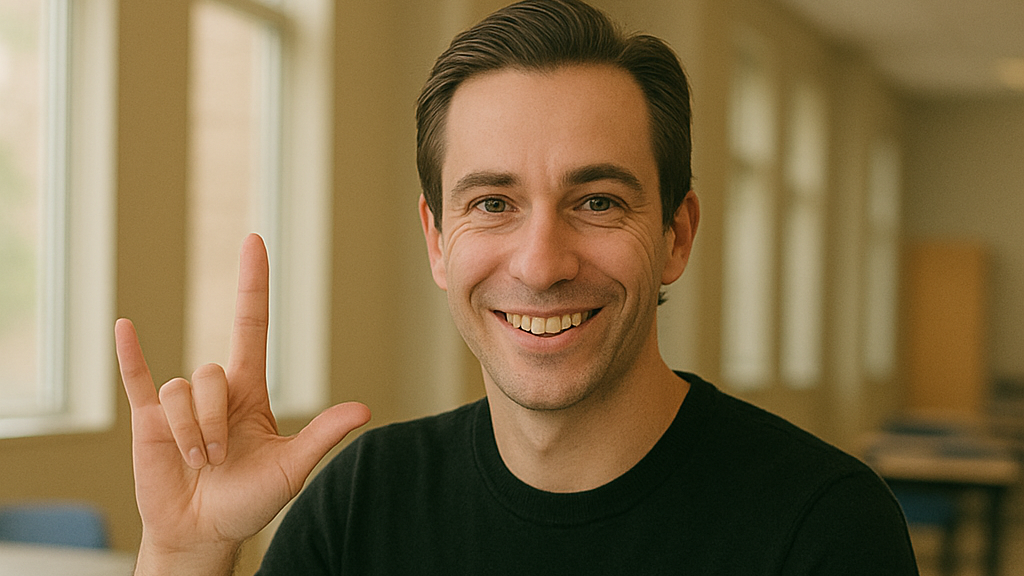
In just two days, I’ll begin teaching ASL again. This year, I’m setting a personal goal: to write twice a week about my experiences in the classroom and document what it’s like to teach a language so deeply tied to my own identity.
Today marked the second day of our annual professional development workshop. Surprisingly, after five years in this district, this was the first time I genuinely enjoyed it. The difference? For the first time in thirteen years of teaching ASL, I had professional interpreters working alongside me.
That decision didn’t come easily. I’m 43 now, and while my hearing has stayed relatively stable, I know it won’t last forever. Like most people, I’ll experience more hearing loss as I age. I hope, pray, cross my fingers, and even knock on wood that it won’t happen soon—but I also understand that hearing loss isn’t something I can control. Accepting the need for interpreters felt like a shift, a small acknowledgment of where I am in life and where I’m headed.
What I didn’t expect was just how transformative their presence would be.
For years, I thought I was following along in these workshops, nodding and contributing to conversations when I felt confident I’d heard enough to chime in. But having interpreters made me realize just how much I’d been missing. It wasn’t just the content of the sessions but the subtle dynamics: knowing when someone had finished speaking, following simultaneous conversations, and truly being part of the dialogue.
One activity in particular stood out. It was called “Four Corners,” and the first slide read Inclusive Welcome in bold letters. Four brightly colored sheets—orange, green, blue, and black—were taped in different corners of the cafeteria. We were given a prompt, like “Superpowers,” and asked to choose between Teleportation, Super Speed, Invisibility, or Mind Reading.
I made my way to the orange corner, glancing at my interpreter and signing “orange” so she’d know where to head. She strategically positioned herself across from me, ready to sign the next prompt once I’d shared my reasoning with a colleague. (I chose Teleportation because I love to travel and would relish the ability to be anywhere instantly. My colleague said she’d choose it for quick breaks from her students—a reason I could wholeheartedly agree with.)
What struck me most was how natural it all felt. While some colleagues struggled to hear the next prompt, I knew exactly what was happening thanks to my interpreter. For the first time, I wasn’t straining, guessing, or overcompensating—I was fully present.
That realization was both comforting and sobering. Without an interpreter, I would’ve been in the same position I’d been in for years: missing critical information and silently piecing together conversations, often incorrectly. It made me wonder how many of my peers might also be quietly struggling with their own hearing loss, reluctant to acknowledge it, just as I had been.
But this isn’t about judgment. It’s about perspective. My experience is a reminder that accessibility tools—like interpreters—aren’t signs of weakness. They’re bridges. They create inclusion, not just for those of us who need them, but for everyone in the room.
After thirteen years of teaching ASL, I’m still learning. I’m learning how to accept help, how to show up more fully, and how to model accessibility for my students. Looking back, I wish I’d done this sooner. But today, I feel grateful—grateful for my interpreters, for this new clarity, and for the chance to start the school year not just as a teacher, but as a participant in the conversations I’ve been missing.
If this resonates with you—whether you’re a teacher, someone navigating hearing loss, or just someone curious about ASL—I’d love for you to follow along. I’ll be sharing more stories from my classroom and my journey, not just to document my own growth but to hopefully spark conversations about accessibility, connection, and learning from one another. Here’s to starting this year with open hands, open eyes, and open hearts.
Leave a Reply